The past is beautiful because one never realises an emotion at the time. It expands later, & thus we don’t have to complete emotions about the present, only about the past.
Virginia Woolf
That’s the quote the book starts with and it’s definitely my favourite one out of the entire reading experience. I came across “Educated” due to the book being talked about simply everywhere: it was on the New York Times bestseller list, it got nominated for numerous awards and the author got interviewed non-stop, among others by Bill Gates and Oprah Winfrey. To sum it up, my expectations were high. I’m usually a huge fan of memoirs but somehow this one didn’t click with me.
If you want to know the essence of the book straight away: It’s a story about a girl who has chased her dreams of getting an education against all odds due to her incredible willpower. With her background of growing up in a strict Mormon family, without any schooling, living in a constant state of emotional abuse, as well as physical abuse at times, it can be said that she managed the impossible. But that’s all you feel towards the story. A simple, “Ah, well that’s a very determined girl/woman! Well done for her! She must have also been intelligent since she made it into some of the best universities out there.” Somehow the emotions didn’t get transferred, which was a real pity since that is normally the essence of a good memoir. It all read like a typical “American Dream” kind of story. As in,” look at this girl who had nothing and came from nowhere but still managed to make it to the top!”
What was interesting and fascinating to me was more the brainwashing side of the story, how the author was indoctrinated by her father’s beliefs until the age of about 16. It’s illustrated really well, how such an upbringing stays deep in your bones, even if you think that you’ve managed to grow out of it and have acquired a different understanding of the world. Whereas I’m sure that the author portrayed all her thoughts in order to stay authentic, it at some point simply became too repetitive to hear how often she reverted to her old beliefs.
I’d been wondering whether something was wrong with me since the beginning of the semester, when I’d attended my first lecture on world affairs. I’d been wondering how I could be a woman and yet be drawn to unwomanly things.
p. 229
I’m sure that such an extreme change to the author’s previous life was quite difficult to understand and to digest, going from working at a junkyard to attending lectures at Oxford, Cambridge and Harvard. It must have been difficult to grasp, how people were now curious about her own opinion and invited her to events, but the way she expressed it at times, was the exact opposite of humble. It just felt like a constantly recurring theme, where she puts herself down again and again, not believing in her own strengths. It’s the wording though that she uses, which failed to evoke any compassion for her in my case.
I became a popular dinner guest, with my stories of hunting and horses, of scrapping and fighting mountain fires.
p. 273
In the end, there were just too many open questions for me in the story, making it less believable. The family lived somewhere in the middle of nowhere, with hardly any income. Nevertheless, they paid their taxes. They were against classical medicine, doctors and hospital but when they got into huge accidents, they did have to send family members to the emergency room multiple times. How did they pay for that? Those kind of treatments must cost thousands and thousands of dollars in the United States, if you don’t have an insurance, as it was the case for the Westover family. How did they afford to buy all those new cars after they crashed their old ones during accidents?
They were told a helicopter would arrive in minutes. […] [T]he doctors had performed a surgery, cutting into his skull to relieve some pressure, or stop a bleed, or repair something.
p. 129
The doctor gave Shawn a CAT scan. […] The hole in the bone was small, the doctor said. […] Shawn said he’d like to see how it healed, so the doctor folded the skin over the hole and stitched it.
p. 147
It seemed like the style and the way the book was written didn’t allow me to warm up to the characters or to get to know them properly until the very end. Even though emotions were described from time to time, they somehow weren’t emotional. It all felt very factual. I don’t know whether this was done intentionally or if it was an automatic reaction since the author doesn’t have an existing relationship with the majority of her family anymore.
Why still a 3 star rating then? I do think that this book is relevant and Tara’s story is quite a fascinating one. A 4 ★ book is one that I would recommend to a friend, which isn’t necessarily the case for “Educated”. I didn’t feel like it was lost time reading it though, since some very relevant messages were transported. It seems like it would be really relevant to younger readers if brought forward as a narrative by the parents, in order to shift their perception of schooling. Presenting a story of where it’s not an, “Ugh, I have to go to school” but rather understanding the privilege of being able to go to school.
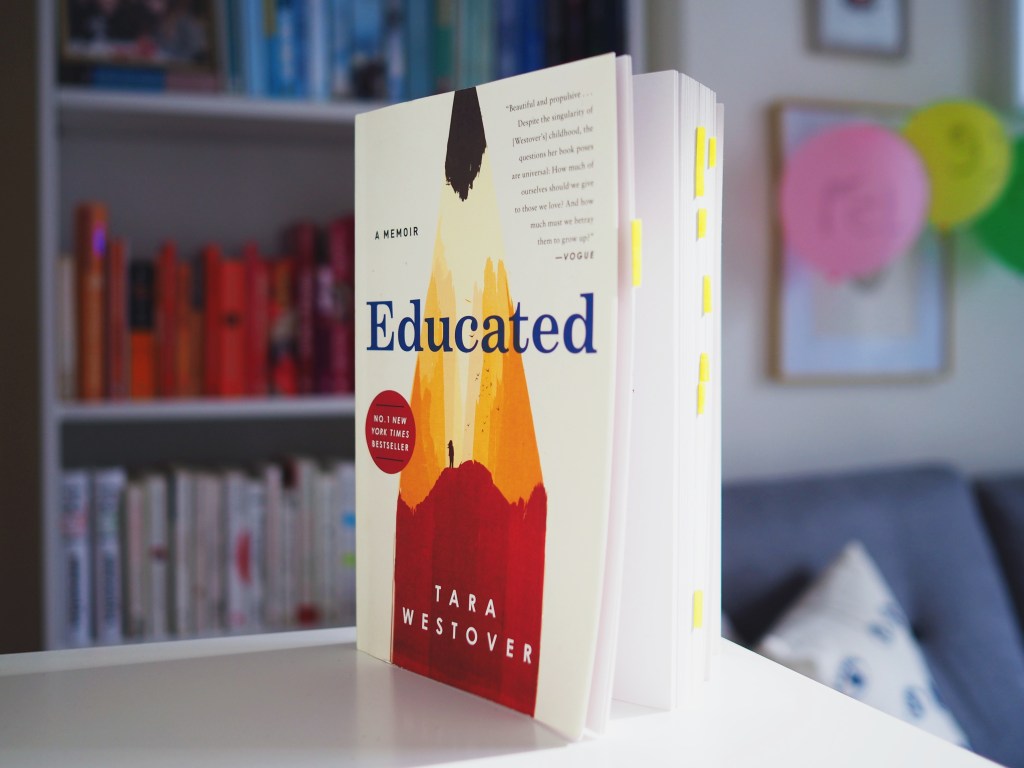
★★★☆☆ (3/5)
Edition: ISBN 978-1-9848-5485-8
Random House, 2018
 VK READS