Reni Eddo-Lodge’s book “Why I’m No Longer Talking to White People About Race Anymore” having touched upon the topic of Black hair, its particularities and what it’s like to stand out with it, while living in a predominantly white society made me curious about Emma Dabiri’s book that is mainly dedicated to the topic of hair. I found it extremely fascinating and eye-opening, making me become aware of a subject matter that I have never been confronted with before.
‘Unruly’, ‘defiant’, ‘unmanageable’, ‘coarse’. Consider these terms in the context of the regulatory nature of policies around our hair. Language that is now culturally acceptable – the language of colony or the plantation, the language once employed to describe black people – has not vanished; it has simply shifted to head height.
p. 11
The only reason why I reduced the final rating by one ★, was due to the contrasting styles within the book. It swerved from highly serious academic passages to colloquial expressions, which didn’t quite fit together well. It felt like different parts of the book were written during different periods of time, the transitions not being fluent enough to go unnoticed. Some typos also slipped through the editing process, for example on p. 130 or p. 149 among others.
I have neither the energy nor the inclination to react to the seemingly ceaseless instances of cultural appropriation. Don’t @ me, bro.
p. 182
What is life for, if not physical intimacy and communion with out bredrin? If, at the end of the exchange, we look better than we did before, issa win.
p. 165
Nevertheless, the book was so fully packed with information that a white person wouldn’t naturally come across, that I would consider it a “must read” for all white people wanting to open their eyes to different cultures from their own. A variety of topics beyond hair is touched upon, such as cultural appropriation, beauty standards, the current beauty industry, dieting culture, criticism towards the “natural”movement, the perception of time, traditions within some African countries etc.
The time it takes to do Afro hair is, quite frankly, the time that is required to do it. And it is in this fact that a very powerful truth is revealed. Our hair continues to be a space in which the fault lines between an imposed European system and black bodies’ resistance to that system are exposed and played out in real time.
p. 71
If you have heard about fractals – patterns that repeat themselves at many scales and are found in things in nature like our organs, trees, seashells, hurricanes etc. – it might be new to you that these have been used in indigenous African designs much earlier than in European societies (p. 224). Revelations about how differently time is perceived in traditional African understanding (p. 83), how braiding has its place in this whole system or how important African scientists were simply disregarded in order for Europeans to elevate themselves above them (p. 217) were other topics that I curiously devoured. If some of these sound appealing to you too, you’ll surely enjoy this book!
The social meaning encoded into braids’ multiple layers brings with it centuries of accumulated information, beliefs and practices. Braiding operates as a bridge spanning the distance between the past, present and future. It creates a tangible, material thread connecting people often separated by thousands of miles and hundreds of years.
p. 48
I would highly suggest “Don’t Touch My Hair” to all those who would like to act as anti-racists in our current day society. Reading other people’s reviews, it also sounded like it could be an interesting piece of writing for Black people as well, in order to see some of their past, upbringing and current judgement in society illuminated by a different light.
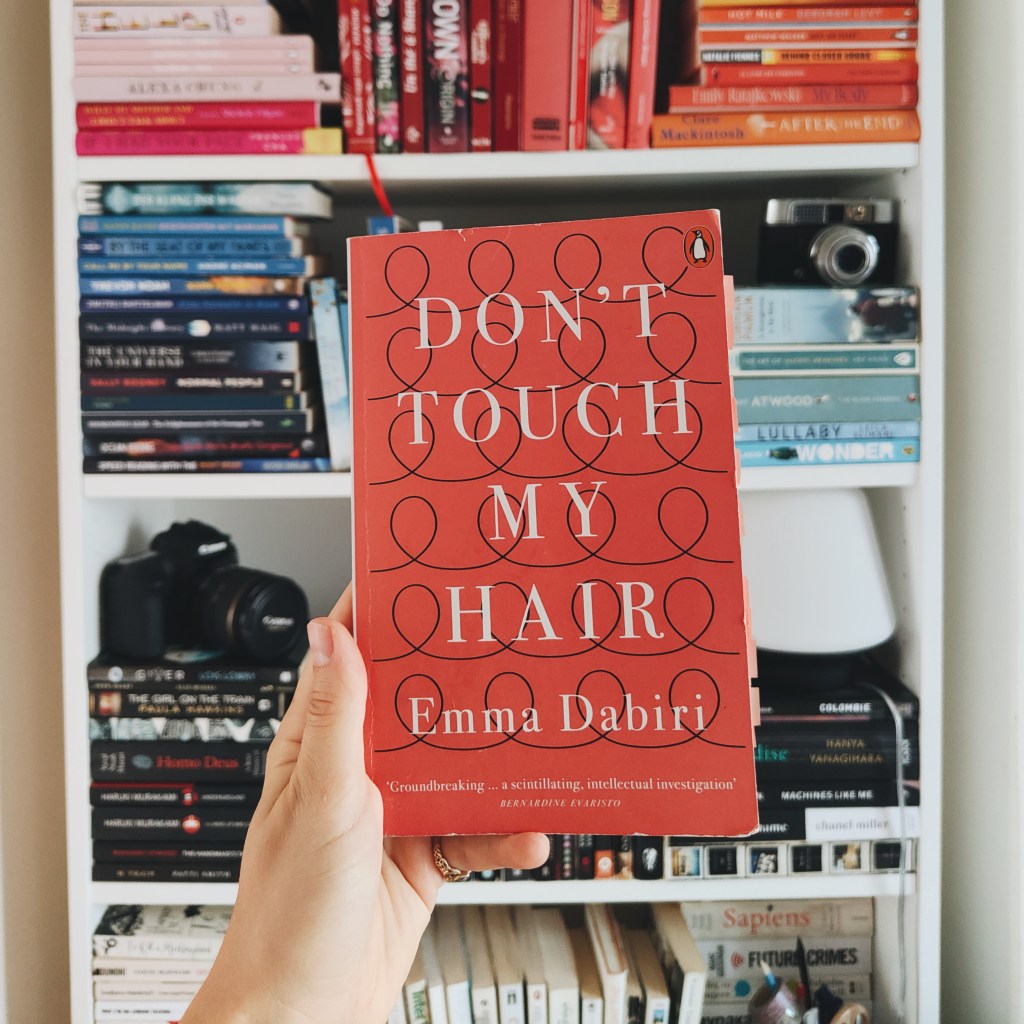
★★★★☆ (4/5)
Edition: ISBN 978-617-760-605-4
Picador, 2022
 VK READS