This book had everything I could have wished for from a piece of fiction and more, so this was a strong 5/5 ★ read for me! It had beautiful style, a captivating story, well developed characters (especially considering over how few pages the story stretched) and some really important themes that have been tackled. You will be reading about religion, the circumstances of growing older, of being dependent on a caregiver, about mother-daughter relationships, abortions and you’ll also get an insight into what having Parkinson’s disease feels like. And all of this unfolded over just around 140 pages! I found this to be one of the most remarkable aspects of the book. I have previously read many other novels, such as “Tomorrow, and Tomorrow, and Tomorrow“, which felt forced with the amount of topics they tried to cover and didn’t do it properly for any of them. Within “Elena Knows” though, it was managed with perfection by the author.
[…] [T]hat’s something the Parkinson’s won’t allow. That’s its name. Elena knows she hasn’t been the one in charge of some parts of her body for a while now, her feet for example. He’s in charge. Or she. And she wonders if Parkinson’s is masculine or feminine, because even though the name sounds masculine it’s still an illness, and an illness is something feminine Just like a misfortune. Or a curse.
p. 2
So Parkinson’s is Herself and dopamine is the messenger. And her brain is nothing, she thinks, because her feet don’t listen to it. Like a dethroned king who doesn’t realise he’s not in charge anymore.
p. 3
Most importantly though, this story gave me what I always hope to get when reading fiction. It made me feel all kinds of different emotions! Sadness, compassion, shock, anger, suspense and surprise. You’ll be in for a rollercoaster ride of a huge range of them. You could for example read as much research and non-fiction on Parkinson’s but this book will make you dive headfirst into its universe and lay it out in an almost tangible way of what it’s like to have it. You could listen and read about the opinions for and against abortion but here it was laid out in such a way that you could really feel through them.
The Church condemns suicide just as it condemns any murder, any wrongful use of the body that does not belong to us, whatever name you to give the action, suicide, abortion, euthanasia. Parkinson’s, she says, but he ignores her.
p. 53
That afternoon your daughter told me that if I had an abortion I’d hear a baby crying in my head for the rest of my life, but she hadn’t had an abortion, she didn’t know, she was repeating what someone else had told her, maybe a man, maybe not, but someone who thought they knew.
p. 125
From the way the book started, to the way the narrative was constructed – taking place over just a single day, including flashbacks towards the past – up until to how it finally ended, it was all masterfully crafted. I was kept guessing until the very end and by the moment I thought I had the plot figured out, I was in for a final surprise. Even the separation into its three different parts had so much meaning to it, corresponding with the timing and the amount of pills the main character needed to take in order to make her body function physically while living with Parkinson’s (“I. Morning. Second Pill”, “II. Midday. Third Pill” and “III. Afternoon. Fourth Pill”). I really enjoy it when the author weaves in the title of the book into the storyline and here you will get to savour all of the nuances around it, evolving together with the events.
[…] Elena knows, because she knows Herself almost as well as she knew her daughter.
p. 20
The nuances of each of the character’s facets were brought to light with razor-sharp observational skills. I especially appreciated how they were gradually introduced, giving each of them space to unfold, not confusing the reader with all of them at once from the beginning on. Taboos were broken when it was expressed what the caregiver felt like while taking care of her sick mother. The story of an individual was presented, who regardless of how much her physical capabilities were diminishing, still had the will and the motivation to continue fighting, wanting to live on. The bureaucratic nightmares of our current day society and all their intricacies were revealed. It was depicted how cruel the world towards people who exist outside of the norm of physical abilities is and what it means to live in these conditions, day in, day out.
[…] [T]hey pass in front of her, they move away, so many pairs of feet. And Elena keeping to the lane that only she can see. Someone crashes into her and apologises without waiting for her response. Another person steps around her but the backpack hanging from their shoulder smacks into her, brutal and uncaring.
p. 69
My appetite for more of Claudia Piñeiro’s writing has been awakened and I’m sure that this won’t be the last book of hers that I will read. I’m also looking forward to watching the movie adaption of this story, which has been released on Netflix this year. If you’re looking for a short and fast paced piece of fiction, don’t hesitate and go for “Elena Knows“, I’m sure you won’t regret it! And if you’re already planning ahead for 2024, do consider adding it to your repertoire of the year. On top of it all, I would highly suggest you to get this exact copy of the book as it includes a really valuable afterword, which might have been one of the best ones I have read for a novel!
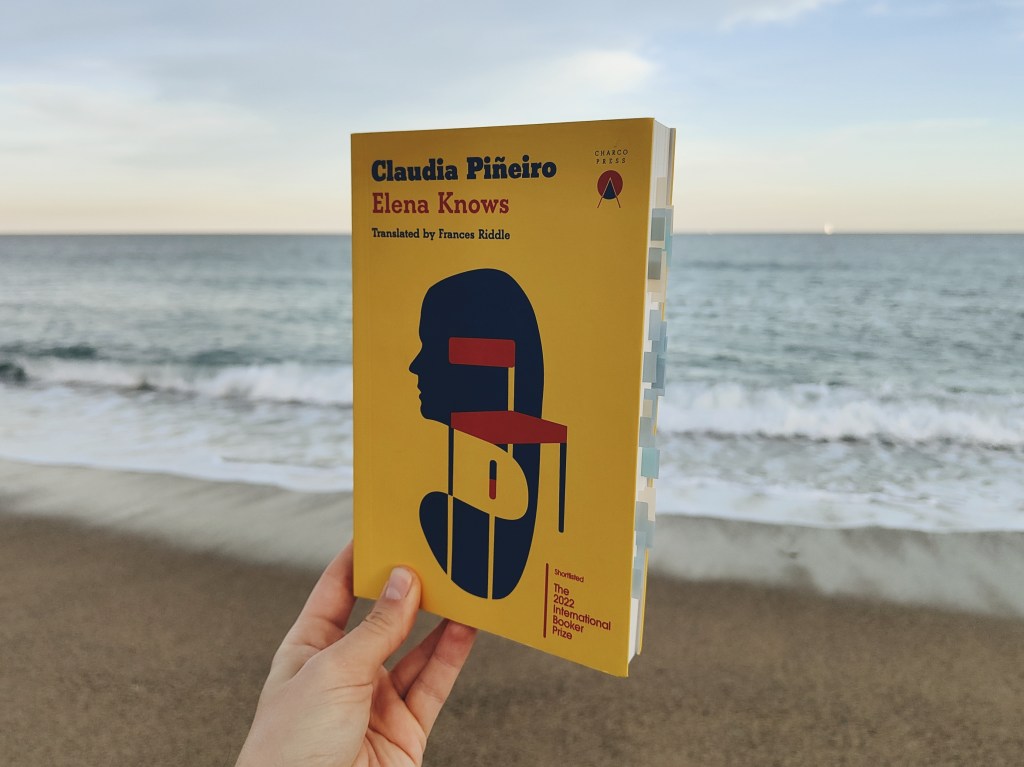
★★★★★ (5/5)
Edition: ISBN 978-1-9993684-3-2
Charco Press, 2021 (first published in 2007 in Spanish)
 VK READS