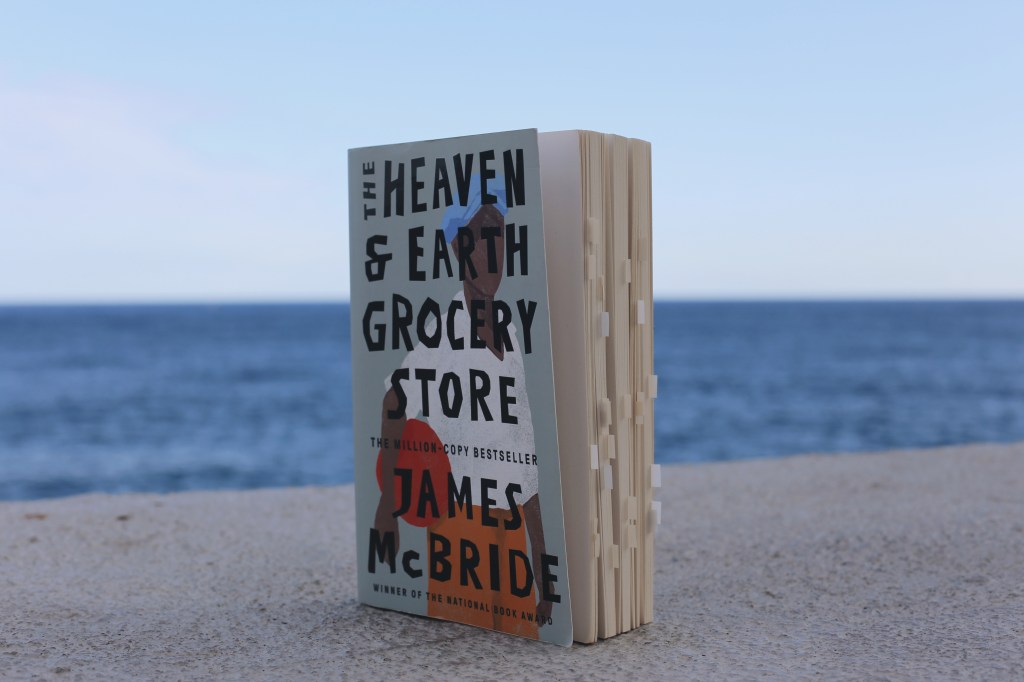
This book just wasn’t my cup of tea… To sum it up, below are the main reasons why I didn’t enjoy it. If these points sound like deal breakers to you and aspects due to which you can’t imagine having an enjoyable reading experience, you should probably skip this one:
- Tons of different storylines, often leaving you confused;
- Tons of different characters, not being able to go in depth with any of them;
- A story noticeably told from a male perspective;
- A style that sometimes came off as awkward and repetitive, dialogues not sounding natural.
In my opinion, this book suffered from the classic case of trying to put too many different themes into a single novel. Whereas there was potential in the individual narratives, their amount and the way they have been linked together was executed in a chaotic way. Reading the acknowledgements in the end, you understood that the author started off with an idea to write about a center for handicapped children. What ended up in the final mix were a lot of immigrant stories, relations between the Black and Jewish communities, some stories of friendship, conflicts around race and some narrative around the musical scene, one of the characters having been portrayed as a musical theater director. It felt like there was a lack of focus, the story was often going nowhere and in all kinds of different directions all at once.
The worst thing to me as a reader was the humongous amount of characters that was used. I needed to draw out a character map in order to follow the evolution of who was who and the interrelations between all the people mentioned. So many different names were dropped, that it was incredibly difficult to remember them all. By the end, you would end up realising that hardly any of them mattered for the advancement of the plot. It was frustrating at best and highly annoying at its worst. I wouldn’t suggest this book to anyone who is wary about an excessive amount of characters in a single story. Below an example of how they were constantly introduced:
The home next door to Chona’s Heaven & Earth Grocery Store was occupied by the lovely Bernice Davis, sister of Fatty Davis. Like Fatty, Bernice was related to just about every black person on the Hill. She was second cousin to Earl “Shug” Davis, driver for the vice president of Pottstown Bank; second cousin to Bobby Davis, who once worked as an all-around handyman for Buck Weaver, the great Pottstown baseball player who played for the Chicago White Sox; and also, by dint of a twisted, convoluted intermarriage between her grandfather and his son’s stepdaughter, was great-aunt to Mrs. Traffina Davis, the wife of Reverend Sturgess, meaning Bernice was actually twelve years younger than her great niece. She also served as stepsister to Rusty Davis, the handyman who fixed everything; fourth cousin to Hollis Davis, the Hill’s only locksmith; and polished it off by being niece to Chulo Davis, the legendary jazz drummer who left Chicken Hill to play with the famous Harlem Hamfats in Chicago before he was shot dead over a bowl of butter beans.
p. 93
While trying to figure out my rating for the book, I honestly had enormous difficulties of thinking of any positive points to mention. Due to the main issues mentioned in the beginning, it was often a struggle to read on, I had to force myself to pick the book up again and again. If it wasn’t for a book club deadline to discuss it, it would surely have taken me five times the amount of time to finish it. It didn’t help that the style didn’t have anything particular or appealing to it. It was kept simple but the dialogues often felt awkward, not sounding natural, being heavy handed and written with an annoying amount of repetitions. The example below illustrates it well how the exact same phrase kept coming up four times within the same dialogue:
“I got something for you,” she said. “You’ll like it.” […]
“I said I got something for you,” she said. […]
“I got one question. And after you answer it, I’ll leave what I brung you and go on about my business.” […]
“I do got something to give you. But I got a question to ask you first.”
p. 286-288, p. 291
The man was big, and the weight of the arm felt heavy, the bicep stiff and hard against Plitzka’s neck. He spoke with a foreign accent. Plitzka guessed Russian. Probably Jewish. Damn Jews. Hoodlums. He felt rage and fear in his gut.
p. 359
“Get your arm off me.”
The man’s arm felt like a block of wood. The heavy arm lifted slowly. “Mr. Rosen said to tell you he’s lonely,” he said.
“Tell him to get a dog.”
“He’s already got one. Me. Wanna see my teeth?”
This year I have been focusing on reading books by predominantly female authors, making one of the few exceptions for this one, it having been picked by the “Chapters for Change” book club in Barcelona. The difference was instantly noticeable though. The way that women were described revealed how different a story sounds when it’s told from a male perspective. Hardly any female character would get through the story without having details shared on what their breasts were like…
Paper—whose smooth dark chocolate brown skin, perky breasts, slim buttocks, and wild cornrowed hair was appended by her running mouth that could keep neither secret nor food, for she ate like a horse but never gained an ounce—was a laundress who held court inside the Heaven & Earth Grocery Store every Saturday.
p. 81
He’d not forgotten it, and when she walked into his office, he still felt the pounding of a thousand drums in his heart, for she had aged well. The beautiful breasts, the slim hips, the bright, shining eyes were still there, along with the Skrup Shoe on her foot.
p. 124
He hadn’t seen Chona in years. He never forgot the Jewish goddess standing at her locker in high school, her shining eyes, the full breasts, both of them young and innocent, the years ahead of them looking so promising.
p. 127
Taken the fact that the book was published in 2023, the author and the editing team could have made the effort of verifying the correct spelling of the Ukrainian capital city, instead of using its Russified version:
His name was Henry Lit. He was thirty-four, a Russian Jew from Kiev, a former boxer, and a hopeless gambler.
p. 361
Another thing that bothered me, were the random critical commentaries on society in the future, which popped up throughout the story and didn’t fit in with the rest of the style the book was written in or the time it was set in. The moments when they were brought up didn’t feel fitting either. Imagine a criticism on mobile phones in the future being triggered by the smell of a hot dog… Yup, it was that weird…
[…] Chona had smelled not a hot dog but the future, a future in which devices that fit in one’s pocket and went zip, zap, and zilch delivered a danger far more seductive and powerful than any hot dog, a device that children of the future would clamor for and become addicted to, a device that fed them their oppression disguised as free thought.
p. 225
The town did not erect a statue in his honor. All the myths he believed in would crystallize into even greater mythology in future years and become weapons of war used by politicians and evildoers to kill defenseless schoolchildren by the dozens so that a few rich men spouting the same mythology that Doc spouted could buy islands that held more riches than the town of Pottstown had or would ever have. Gigantic yachts that would sail the world and pollute the waters and skies, owned by men creating great companies that made weapons of great power in factories that employed the poor, weapons that were sold cheaply enough so that the poor could purchase them and kill one another. Any man could buy one and walk into schools and bring death to dozens of children and teachers and anyone else stupid enough to believe in all that American mythology of hope, freedom, equality, and justice.
p. 374
To finish it all off, the ending didn’t feel satisfying but rather underwhelming. A part of it felt like it was wrapped up in a very rushed way, being swept under the carpet and into an epilogue. The last 30-50 pages leading up to it read like the pinnacle of the chaos of the narrative, which left me completely lost, not understanding how the events came together and why certain things were happening. The only aspect that made the hours I’ve forced myself to get through this chore of a book worthwhile, was the discussion that we had with the book club. A beautiful comparison that was made, was how the storytelling style could be compared to the sound of improvised jazz, flourishing in its seeming disorder. It became apparent that the people that enjoyed “The Heaven & Earth Grocery Store“, focused on the fact that it wasn’t about the individual characters and understanding them deeply but rather about the interactions among them, shaping a patchwork of a picture of a diverse community.
★☆☆☆☆ (1/5)
Edition: ISBN 978-1-3996-2041-3
Weinfeld & Nicolson, 2023
 VK READS