This book has got to be the worst one I have read in 2023. Having started reading it in November 2022, it took me three attempts to finally finish it. When starting reading it for the third time, my only personal motivation was to prove my perseverance and my patience by fighting my way through it.
I can assume that you would need to have the following qualities in order to have a better time reading the book than I did:
- To be a fan of historical novels and to enjoy magical realism;
- To enjoy extremely long passages with extremely detailed descriptions that don’t contribute to the advancement of the plot;
- To like books with tons of different characters.
In my case, those three points have not been met:
- The novel having been set in Istanbul around the 1590s, it just didn’t manage to capture my interest;
- The book ended up being a miracle solution for falling asleep, no matter when I picked it up, it worked just as well as a sleeping pill to make you want to shut your eyes after just a couple of minutes. It dragged on way too much for me and the 666 pages ended up being pure torture. I kept on going back and re-reading passages because my attention simply wasn’t held long enough;
- I kept on getting confused with various characters and their names, having had to write out character maps after my second attempt at reading the book, which I used upon picking it up for the third time. Another book that I recently read and with which I had a similar problem, was “To Paradise” by Hanya Yanagihara but at least there the interesting plot spiked your curiosity and motivation to figure out who was who. Below are the character notes that I ended up writing out while reading:

Whereas it all started out in a quite unique way, with the first chapter having been written from the point of view of a corpse, it got too much for my taste. By the time I got to the chapters written by a speaking tree or a speaking gold coin, I slowly started losing my mind. Even though each of the 59 chapters was quite short, being about 10 pages long on average, this didn’t help out with the motivation of continuing on with the reading. Objectively, I would have put down the book before reaching page 100 and it was only my stubbornness that made me push through and finish it. The general style reminded me of “The Enlightenment of the Greengage Tree” by the Iranian author Shokoofeh Azar, which was similarly filled with magical realism and which I wasn’t a fan of. Below a couple of examples of what kind of passages you will end up reading.
What mischief, what a crude lie! Clearly, Husret of Erzurum is being confused with Nusret of Erzurum, so let me proceed to tell you the story of Cross-Eyed Nedret Hoja of Sivas and the Tree.
p. 79
Yes, when the worldly realm was repeatedly presented through the same stories and pictures, as if time did not flow, Fahir Shah’s small army routed Selahattin Khan’s soldiers – as Salim of Samarkand’s concise History attests.
p. 112
The general plot of the story was based on a murder mystery among a group of minituarists but the most disappointing part was when you actually found out who the murderer was. I felt like you weren’t able to form a close relationship with any of the characters, so in the end, you didn’t even care about who finally got killed by whom. The only reason I would see the potential of this book becoming a “modern classic” in the likes of “Anna Karenina” or “War and Peace” would be due to its length and the amount of attention it requires from the reader to get through the horribly boring parts. It was only about halfway into the book that it became a bit more interesting but this trend ceased within about 50 pages. After that you descended back into the regular suffering as a reader. Here another example of how the majority of the book went like:
The fight was a lengthy one. The Turanian shot arrows; the Persian maneuvered his sword and horse skillfully; and finally, the mysterious Persian felled the Turanian after catching him by the tail of his steed. He then chased after Shengil who was trying to escape, and grabbed him by his armor from behind before taking him by the neck.
p. 600
Besides all those points, the couple of passages that were stylistically beautiful simply could not add up to something higher than the lowest rating of 1/5 ★. The “cherry on top” were the numerous accounts of paedophilia or rape which made me flinch every time I stumbled across another one of them.
In order to seduce this boy-apprentice of unimaginable beauty, as a true lover would do, he schemed and joined in power struggles between miniaturists […].
p. 116
How gentle and curvaceous I made the rear end, lovingly wishing to cup it in my hands like the gentle butt of a boy I was about to violate.
p. 443
I have previously read two other books by Orhan Pamuk, having rated “The Museum of Innocence” with 3/5 ★ and “A Strangeness in My Mind” with 4/5 ★ but I think that I might stop here on “My Name is Red“. If you were curious about discovering something by this Nobel Prize winning-author, I’d suggest you to start with one of his shorter books, “Snow” or “Istanbul” for example. I haven’t and probably won’t end up reading them myself though, so proceed at your own risk.
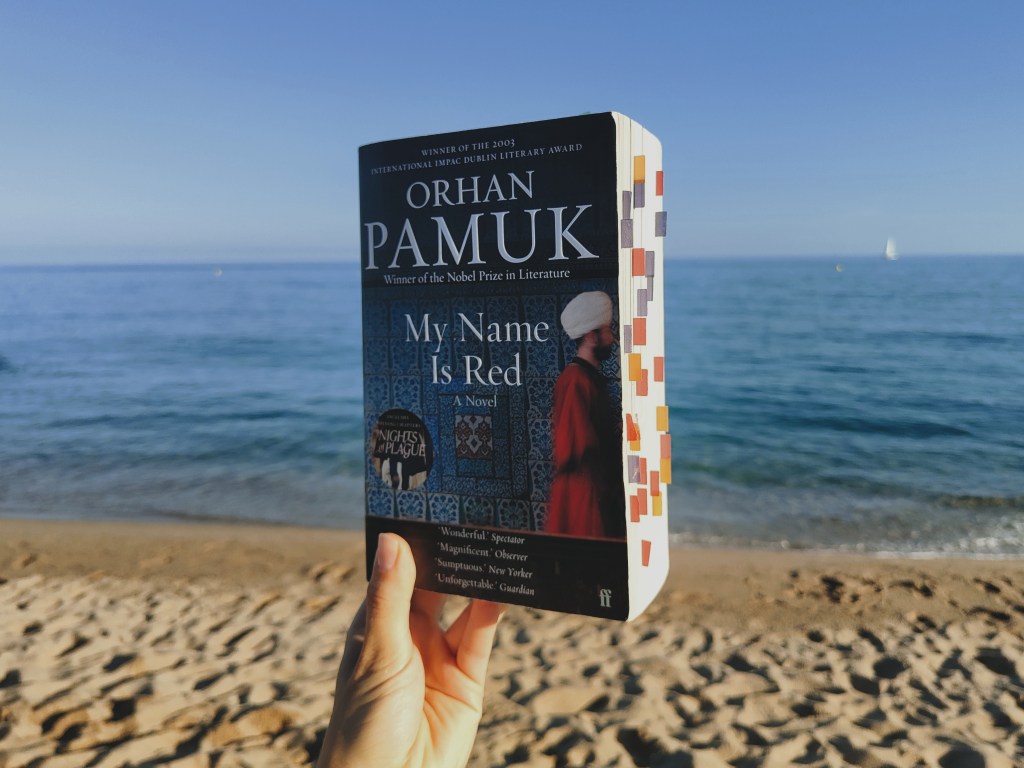
★☆☆☆☆ (1/5)
Edition: ISBN 978-0-571-26883-2
Faber & Faber, 2022 (first published in Turkish in 1998)
 VK READS